















Product Description
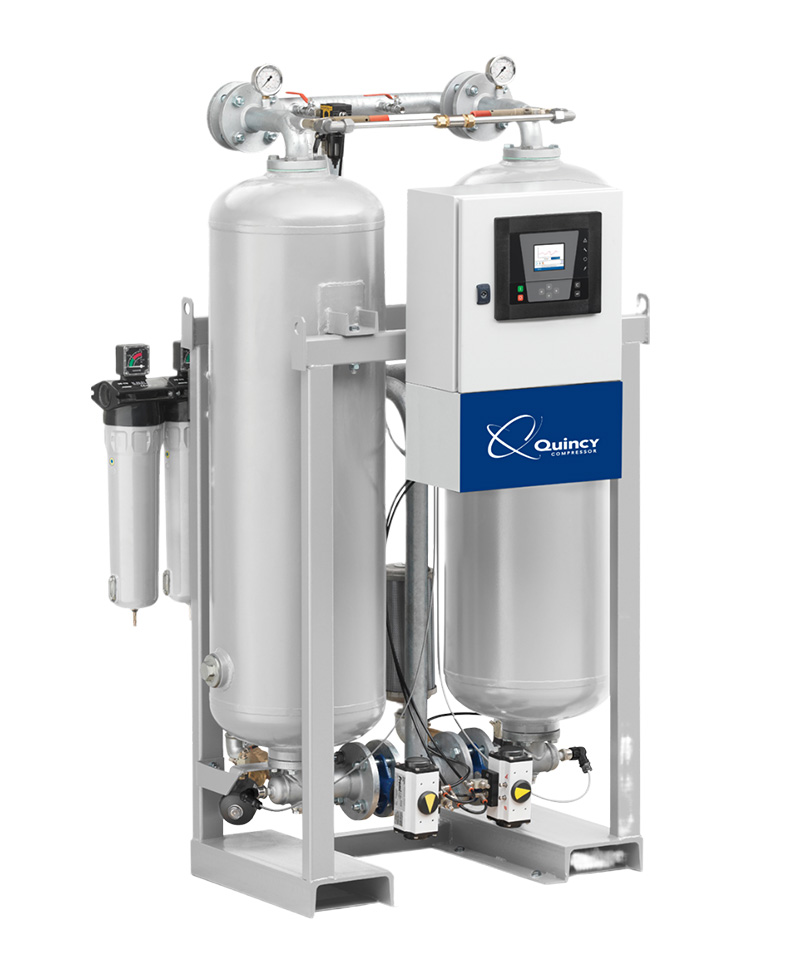
Quincy QHD Desiccant Dryers
The Quincy QHD Desiccant Dryers are heatless regenerative air-treatment systems designed to remove water vapour from compressed air. Therefore, they help protect pneumatic equipment, instruments, pipelines and finished products from moisture-related damage.
The QHD range includes 13 models delivering between 230 and 3,600 CFM at a rated pressure of 100 psig. Moreover, available configurations provide pressure dew points from -40°F to -100°F, making the range suitable for demanding industrial processes.
Heatless Dual-Tower Operation
Each QHD dryer contains two desiccant-filled towers. While one tower dries the compressed air, the second tower regenerates.
During normal operation, wet compressed air flows upwards through the active drying tower. Consequently, moisture adheres to the desiccant while clean, dry air continues downstream.
Meanwhile, approximately 15% of the dried air is diverted through the off-line tower. This purge air expands to atmospheric pressure and removes retained moisture from the desiccant.
Afterwards, the towers automatically switch duties. Therefore, the Quincy QHD Desiccant Dryers can provide continuous dry-air production without stopping the compressed-air system.
Key Features and Benefits
The QHD heatless dryer range provides several practical advantages:
- 13 available QHD models
- Capacity from 230 to 3,600 CFM
- Rated performance at 100 psig
- Pressure dew points from -40°F to -100°F
- Automatic dual-tower regeneration
- Approximately 15% purge-air consumption
- Microprocessor-based control
- Heavy-duty steel base
- Low initial purchase cost
- Low routine maintenance cost
- Continuous compressed-air drying
- Minimum desiccant contact time of 4.5 seconds
- Air velocity maintained below 50 ft/min
- ASME and CRN-designed pressure vessels
- Two-year comprehensive warranty
Together, these features support reliable compressed-air quality while helping minimise equipment downtime.
However, heatless regeneration uses part of the dried compressed air. Consequently, its operating cost may be higher than heated or blower-purge alternatives in some installations.
Controlled Airflow Through the Desiccant
The Quincy QHD design keeps air velocity below 50 feet per minute. Therefore, the compressed air remains in contact with the desiccant for at least 4.5 seconds.
This controlled contact time allows the desiccant to adsorb moisture effectively. Moreover, reduced velocity helps limit desiccant movement and unnecessary pressure drop.
As a result, the dryer can maintain stable performance when operated within the specified flow, pressure and temperature limits.
Automatic NEMA Operating Cycle
The Quincy QHD Desiccant Dryers operate on an automatic 6- to 10-minute NEMA cycle.
A typical operating cycle includes:
- Three to five minutes of drying
- Approximately 2 minutes 25 seconds to 4 minutes 20 seconds of regeneration
- Approximately 40 seconds of repressurisation
During repressurisation, the regenerated tower gradually returns to operating pressure before the switching valves change position.
Consequently, this controlled transition helps reduce pressure disturbance in the downstream compressed-air system.
Low Pressure Dew Point
Pressure dew point indicates the temperature at which moisture would condense from compressed air.
The QHD range provides pressure dew points from -40°F to -100°F. Therefore, it can supply extremely dry compressed air for applications where moisture may cause corrosion, product contamination, freezing or instrument failure.
However, users should select the required dew point according to the actual process. For example, standard industrial instrument air may require a -40°F pressure dew point, while specialised applications may require the lower -100°F option.
Microprocessor Control
A microprocessor manages the drying, regeneration, switching and repressurisation cycle. Consequently, the heatless desiccant dryer operates automatically without requiring continuous operator adjustment.
Moreover, automated control supports repeatable cycle timing and dependable tower switching. As a result, maintenance teams can monitor operation more easily and respond promptly to abnormal conditions.
Quincy QHD Applications in India
The Quincy QHD Desiccant Dryers may suit many compressed-air applications across India, including:
- Instrument-air systems
- Oil and gas facilities
- Chemical-processing plants
- Pharmaceutical manufacturing
- Food and beverage production
- Pneumatic control systems
- Electronics manufacturing
- Painting and finishing operations
- Outdoor compressed-air networks
- Mining and quarry equipment
- General industrial manufacturing
- Processes requiring very low dew points
For example, an outdoor pneumatic line may require dry compressed air to prevent internal condensation. Similarly, a process-control system may require low-dew-point instrument air for reliable valve and actuator operation.
Selecting the Correct Quincy QHD Dryer
Correct dryer selection depends on:
- Required airflow
- Operating pressure
- Inlet-air temperature
- Required pressure dew point
- Compressor capacity
- Ambient temperature
- Maximum acceptable pressure drop
- Air-quality requirements
- Operating hours
- Available installation space
Therefore, users should apply the relevant correction factors when operating conditions differ from the rated conditions.
Otherwise, an undersized dryer may not achieve the required airflow or pressure dew point.
Why Choose Quincy QHD Desiccant Dryers?
The QHD range combines automatic dual-tower regeneration with straightforward heatless operation. Moreover, its broad capacity range, low routine maintenance requirements and very low dew-point options support demanding compressed-air installations.
Therefore, it is a practical choice for facilities across India that require dependable moisture removal, continuous dry air and simplified system operation.
Product Enquiries in India
The Quincy QHD Desiccant Dryers are presented through Pumps Bharat for oil and gas, chemical processing, pharmaceuticals, food production, electronics, mining and general industrial compressed-air applications across India.
When submitting an enquiry, please provide the required airflow, operating pressure, inlet-air temperature, required dew point, operating hours and compressor details. With this information, the available Quincy QHD dryer configurations can be evaluated against the application requirements.