















Product Description
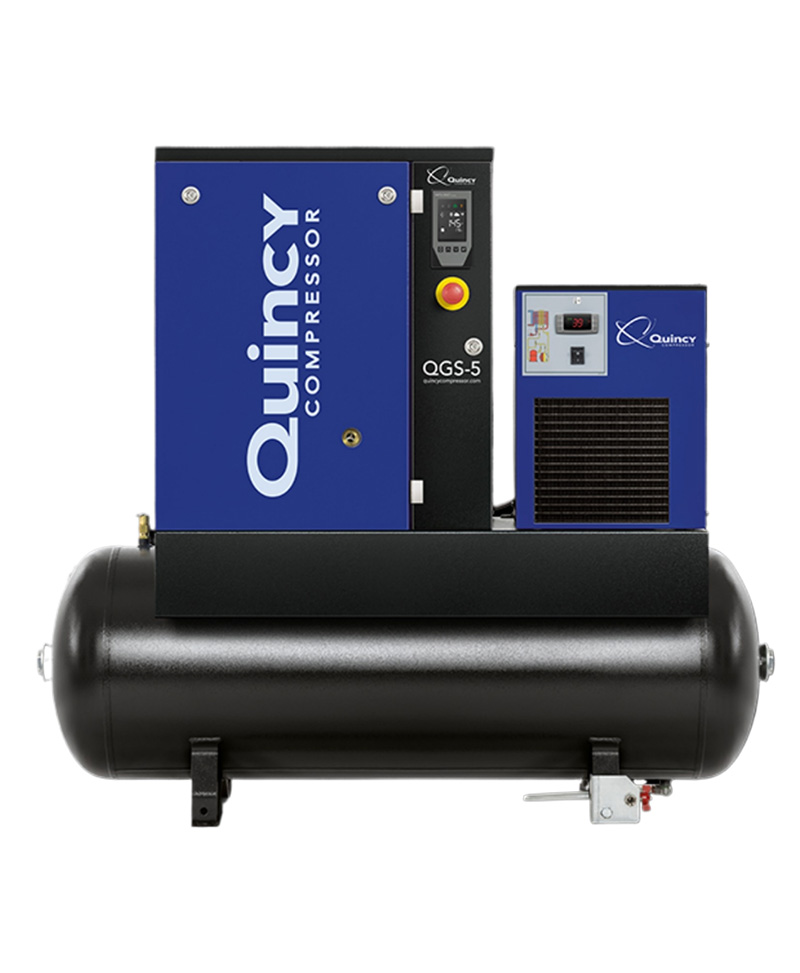
Quincy QGS 5–100 HP
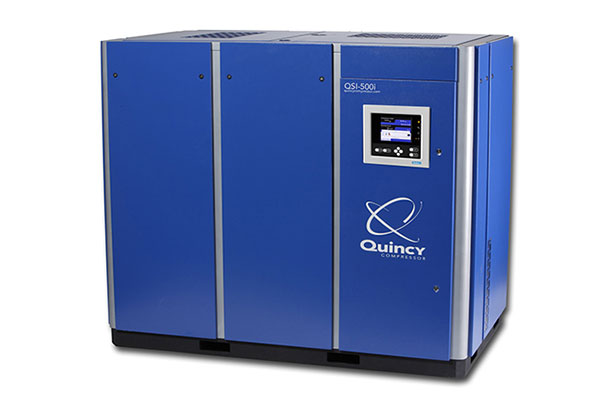
The Quincy QGS 5–100 HP range consists of fixed-speed, oil-injected rotary screw compressors for workshops, manufacturing plants and continuous industrial compressed-air applications.
Published models deliver approximately 16.8 to 414.6 CFM, depending on horsepower and operating pressure. Moreover, the range includes compact receiver-mounted packages and larger floor-mounted configurations. Therefore, users can match the compressor with moderate as well as high industrial air demand.
Continuous Rotary Screw Performance
The QGS compressor uses rotary screw technology to produce a steady supply of compressed air. Two rotating helical elements continuously compress incoming air instead of operating through separate piston strokes.
Consequently, the compressor produces smoother airflow with comparatively low vibration. Moreover, Quincy designs the range for 100% duty-cycle operation, making it suitable for processes that require sustained full-flow capacity.
Key Features and Benefits
The fixed-speed rotary screw compressor range provides several practical advantages:
- Power ratings from 5 to 100 HP
- Airflow from 16.8 to 414.6 CFM
- Selected pressures of 125 or 145 psig
- Fixed-speed rotary screw operation
- Designed for 100% duty cycle
- TEFC IP55 drive motor
- Quiet industrial enclosure
- Low oil carryover
- Air-cooled aftercooler
- High-efficiency intake filter
- Vibration isolation
- Upward cooling-air discharge
- 8,000-hour synthetic lubricant
- Tank-mounted and floor-mounted options
- Integrated dryer options on selected models
- Five-year True Blue warranty eligibility
Together, these features help the Quincy QGS 5–100 HP provide dependable compressed air while controlling maintenance requirements and overall ownership costs.
Published Performance Range
Published performance at 125 or 145 psig includes:
- QGS-5: 16.8 CFM
- QGS-7.5: 25.3 CFM
- QGS-10: 38.8 CFM
- QGS-15: 54.9 CFM
- QGS-20: Up to 82.2 CFM
- QGS-25: 99.4 CFM
- QGS-30: 113.8 CFM
- QGS-40: Up to 176.1 CFM
- QGS-50C: 203.1 CFM
- QGS-60: 262.5 CFM
- QGS-75: 320.2 CFM
- QGS-100: 414.6 CFM
Therefore, users should select the compressor according to required airflow at the actual system pressure rather than horsepower alone.
Tank, Base and Dryer Configurations
The QGS range is available in several package arrangements.
Smaller models can use a 60-gallon horizontal receiver, while selected configurations are available with a 120-gallon receiver. Moreover, Quincy offers base-mounted packages and receiver-mounted units with refrigerated air dryers on suitable models.
Consequently, users can install a compact complete-air package or connect a larger compressor to separately sized receivers, dryers and filters.
Motor Starting and Controls
The range uses different starting and control systems according to motor size.
Published configurations include:
- Direct-on-line starting on smaller models
- Wye-delta starting from selected larger ratings
- Infologic2 Connect control on 5–40 HP models
- AirLogic2 Touch control on 50, 75 and 100 HP models
- Swipe controller on the 60 HP model
Therefore, the Quincy QGS 5–100 HP provides control options suited to different electrical loads and operating requirements.
Quiet Industrial Operation
Published sound levels range from approximately 62 to 75 dBA, depending on the selected model.
Moreover, the enclosure and vibration isolation help reduce noise transmission into the surrounding workplace. As a result, suitable QGS models can operate closer to production areas than many open compressor packages.
However, actual sound conditions also depend on room acoustics, ventilation ducting and installation position.
Simplified Maintenance
The compressor places its principal consumables behind a single access panel. Therefore, technicians can reach filters and service components without dismantling the complete enclosure.
In addition, the external fluid-level indicator allows routine checks without removing panels. Meanwhile, a spin-on filter simplifies scheduled replacement.
Consequently, the maintenance-friendly arrangement can help reduce service time and production interruption.
Quincy QGS Applications in India
The rotary screw compressor range may support many applications across India, including:
- General manufacturing
- Automotive workshops
- Construction operations
- Oil and gas facilities
- Mining and quarrying
- Food and beverage production
- Pharmaceutical facilities
- Agriculture
- HVAC manufacturing
- Chemical processing
- Metal fabrication
- Packaging and assembly lines
For example, a workshop can use a receiver-mounted QGS compressor for tools and pneumatic equipment. Alternatively, a factory can use a larger floor-mounted configuration for continuous production air.
Selecting the Correct QGS Compressor
Correct selection depends on:
- Required airflow at operating pressure
- Daily operating hours
- Peak compressed-air demand
- Electrical supply
- Receiver capacity
- Dryer and filtration requirements
- Ambient temperature
- Available ventilation
- Expected future expansion
- Required system pressure
Therefore, users should complete a compressed-air demand assessment before ordering.
Otherwise, an undersized unit may operate beyond its capacity, while an oversized fixed-speed compressor may unload frequently and consume unnecessary energy.
Why Choose Quincy QGS 5–100 HP?
The Quincy QGS 5–100 HP combines proven rotary screw technology with flexible package configurations, quiet operation and straightforward maintenance.
Moreover, its broad output range supports small workshops as well as larger industrial facilities. Therefore, it is a practical choice for businesses across India that require reliable full-flow compressed air and a competitive total cost of ownership.
Product Enquiries in India
The Quincy QGS range is presented through Pumps Bharat for manufacturing, automotive, fabrication, mining, construction, packaging, pharmaceuticals, food production and general industrial compressed-air applications across India.
When submitting an enquiry, please provide the required airflow, operating pressure, electrical supply, daily demand profile, receiver preference and air-quality requirements. With this information, the available configurations can be evaluated against the application requirements.